AutoPost vs Autoblogging.ai for Multi-Language Support
You need French, German, and Japanese posts next month, and AutoPost versus Autoblogging.ai is the decision in front of you. Picking wrong means retranslating every draft by hand or publishing awkward, machine-flat text that readers click away from. Multi-language support is where these two tools diverge most.
This comparison covers language coverage and translation quality, multilingual content modes, bulk generation, localization workflows, one-click publishing integrations, and pricing. By the end you will know which tool fits your language targets and budget, with a clear verdict rather than a hedge.
Quick Verdict: AutoPost vs Autoblogging.ai for Multi-Language Support
If you need to publish content in multiple languages at scale, Autoblogging.ai offers a more complete multilingual automation suite, while AutoPost provides a simpler, more affordable entry point.
The core difference comes down to breadth of language coverage and how much of the publishing workflow each platform handles. Autoblogging.ai supports 35+ languages and bulk generation of up to 500 articles, which matters when a single campaign has to serve readers across several regions. AutoPost, by contrast, is generally positioned as a lighter tool for basic multilingual needs, and its language range and automation depth are typically narrower than what a large agency would require.
| Feature Area | Autoblogging.ai | AutoPost |
|---|---|---|
| Language coverage | 35+ languages | Generally limited to common languages |
| Bulk output | Up to 500 articles per run | Typically suited to smaller batches |
| Integrations | 35+ integrations, including one-click WordPress publish | Usually a smaller set of publishing options |
| Quality controls | Human proofreader included in all plans, 10+ AI modes, 21-point SEO audit | Fewer built-in review and optimization layers |
| Best fit | Agencies and serious bloggers | Hobbyists and low-volume publishers |
For teams running multilingual content automation, the practical question is whether the tool can carry a project from generation through SEO optimization without constant manual patching. Autoblogging.ai covers more of that chain, with SERP competitor analysis, semantic SEO tools, and featured snippet optimization built into the same workflow. That reduces the number of separate services an agency has to stitch together when managing several language versions of the same site.
AutoPost is not without merit. For a blogger testing a second language or two, a lower-cost tool can be a reasonable starting point, and there is no shame in starting small. The trade-off is that scaling up usually means migrating to a heavier platform later, which adds time and friction.
- Choose Autoblogging.ai if you manage client sites, publish across many regions, or need bulk output plus proofreading and SEO checks in one place.
- Consider AutoPost if your multilingual needs are modest, your budget is tight, and you only publish occasionally in one or two extra languages.
In short: agencies and serious bloggers should lean toward Autoblogging.ai for its wider language range, larger batch capacity, and deeper integration set, while casual publishers with light multilingual goals may find AutoPost adequate for their needs.
At a glance: how Autoblogging.ai compares to AutoPost, Autoblogging.ai for Multi-Language Support on the features that matter most.
| Feature | Autoblogging.ai | AutoPost | Autoblogging.ai for Multi-Language Support |
|---|---|---|---|
| Multi-Language Support | ✓ | — | — |
What Is Autoblogging.ai?
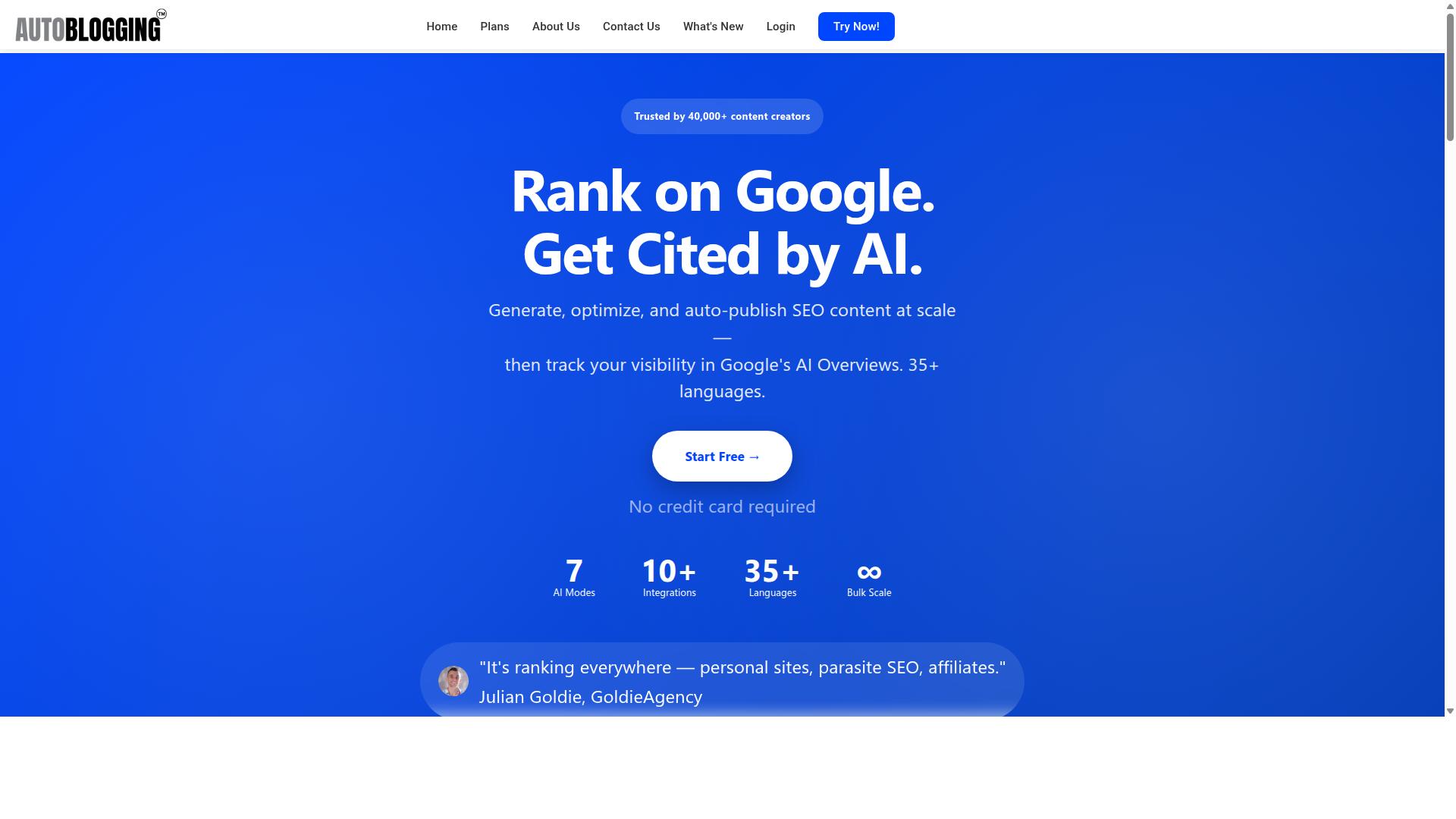
Autoblogging.ai is an AI-powered content generation platform that helps bloggers, agencies, and marketers automate article creation in over 35 languages. It is a product of Digimetriq.com, founded in 2022 by Vaibhav Sharda, and it was built around a straightforward mission: help bloggers, website owners, and agencies save time and improve their online presence through cutting-edge technology.
The platform's stated goal is to cut down content costs and enable human counterparts within their SOPs by delivering a strong first draft. Digimetriq's longer-term aim goes further, toward replacing human counterparts entirely for repetitive content production. For teams weighing multi-language support in tools like AutoPost, that context matters, because it shapes how the product approaches language coverage.
Adoption figures give a sense of scale. Autoblogging.ai is trusted by 40,000+ content creators and has generated 1M+ articles. Those numbers reflect a platform used across many niches and markets rather than a narrow single-purpose tool.
Language coverage is native rather than bolted on. The platform supports multi-language content generation directly, with modes such as Godlike and Bulk Generation available among its 10+ AI modes. It also connects to 35+ integrations, which matters for publishing workflows.
- Product owner: Digimetriq.com
- Founded: 2022, by Vaibhav Sharda
- Mission: save time and improve online presence
- Scale: 40,000+ content creators, 1M+ articles generated
- Capabilities: 10+ AI modes, 35+ integrations
- Languages: content generation in 35+ languages
For a comparison focused on multi-language support, the key takeaway is that Autoblogging.ai treats language coverage as a core capability, not an add-on. Teams producing content for several regions can work within one platform instead of stitching together separate tools for generation and publishing.
What Is AutoPost?
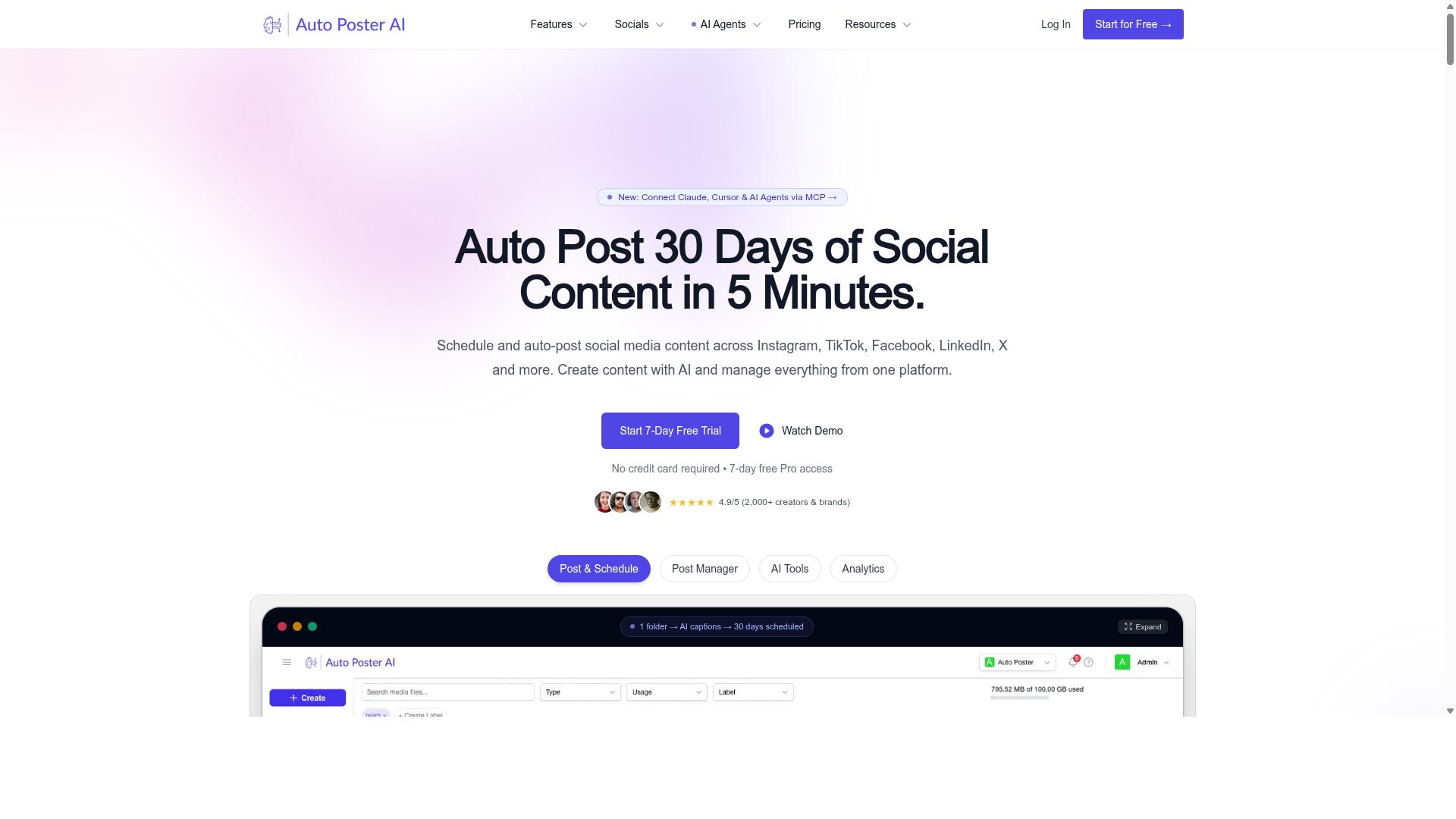
AutoPost is a content automation tool that allows users to schedule and publish posts across various platforms, with some support for multi-language content. It is typically positioned as a way to keep social feeds and blog pages active without manual posting every day.
The core appeal is convenience. Users queue up content, pick a posting time, and let the tool handle automated publishing on a recurring schedule. For teams managing several channels at once, that kind of batching can save real hours each week.
On the multi-language side, AutoPost may offer basic translation or multi-language scheduling, but public details are limited. Some versions appear to let users assign different languages to different posts or profiles, though the depth of that support is not always clear from available documentation.
It is worth noting what this overview is and is not. This is a neutral description based on publicly available information, not an endorsement. Feature sets in this category also change often, so what one version of AutoPost does today may differ from what it does next quarter.
Readers evaluating AutoPost for multilingual content automation should ask a few practical questions before committing:
- Does it translate content automatically, or only schedule posts a user has already translated?
- Which languages are actually supported, and at what quality level?
- Does it connect to a translation API integration such as Google Translate API or DeepL API, or rely on internal machine translation?
- How does it handle language localization for region-specific phrasing, not just word-for-word swaps?
- Can it publish to a blog through a WordPress plugin, or is it limited to social platforms?
Those questions matter because scheduling and translating are two different jobs. A tool can be excellent at one and thin on the other. AutoPost's strength appears to lean toward scheduling and distribution, with translation treated as a supporting feature rather than the centerpiece.
For a marketer running a single-language account, that balance may be perfectly fine. For someone building a site that needs consistent language-specific URLs, localized metadata, and clean indexing across regions, the requirements get heavier fast.
The honest takeaway is that AutoPost is a general-purpose posting tool. It can play a role in a multilingual workflow, but anyone treating it as a complete localization system should verify the specifics directly, since assumptions here tend to cost time later.
What Is Autoblogging.ai for Multi-Language Support?
Autoblogging.ai's multi-language support goes beyond simple translation, offering native content generation in 35+ languages with SEO-optimized output. Instead of writing in English and converting the result afterward, the platform produces articles directly in the target language using its AI modes. That distinction matters for anyone building multilingual content automation at scale.
The core difference is native generation versus machine translation. Tools that rely on Google Translate API or DeepL API convert finished English text into another language, which often leaves awkward phrasing and unnatural keyword placement. Autoblogging.ai generates the article in Spanish, French, German, or any other supported language from the start, so the result reads as though it was written for that audience.
Language handling sits inside the same workflow as the rest of the platform. Quick Mode covers free single-article generation, while Godlike Mode adds SERP competitor analysis, LSI keywords, and knowledge graph extraction, all applied in the chosen language. Bulk Generation pushes this further by producing up to 500 articles through a CSV upload, which means a publisher can queue hundreds of pieces across several languages in one pass.
For example, a site owner targeting both Spanish and French audiences can generate 500 articles in each language simultaneously rather than running two separate projects. Each batch is built for its own market, keeping the content unique and SEO-friendly instead of recycled through content spinning.
Autoblogging.ai also fits the practical side of international SEO. Its WordPress integration supports unlimited sites with one-click publishing, a plugin, and scheduled auto-posting, so translated and natively generated articles can go live on the right language version of a site without manual uploading. The platform's Semantic SEO Analysis, a 21-point audit, and Snippet Optimizer help tune that output for search.
Broader publishing options include Web 2.0 platforms such as Medium, Dev.to, Hashnode, Telegraph, and Tumblr, plus multi-platform support for Shopify, Wix, Webflow, Blogger, and Ghost, along with API, Zapier, and n8n connections. For teams running language-specific URLs, subdomains, or subdirectories, this range makes it easier to route content to the correct destination.
Two related capabilities round out the multilingual workflow. The Content Repurposer extends the life of existing material across formats, and Done For You packages are available for those who prefer a managed approach. Combined with native generation in 35+ languages, these features position Autoblogging.ai as a stronger fit than translation-first tools for publishers who need genuine multilingual content automation.
Features Compared
When comparing multi-language features, Autoblogging.ai and AutoPost differ significantly in language coverage, content modes, and localization workflows. This comparison focuses on five practical criteria: how many languages each platform supports, how natural the translated output reads, which content generation modes are available, whether bulk multilingual publishing is possible, and how smoothly localized articles reach a live website.
The subsections below examine each area in turn, using publicly available feature information rather than hands-on testing. The goal is to help anyone planning multilingual content automation understand where each tool fits.
Language Coverage and Translation Quality
Autoblogging.ai supports over 35 languages with native AI generation, while AutoPost's language coverage is more limited and relies on third-party translation APIs. That difference shapes the quality of the final text more than any other factor in this comparison.
Autoblogging.ai generates content directly in the target language. Nothing is translated after the fact. The model writes natively in German, Spanish, Japanese, or any other supported language, which produces phrasing that reads naturally to native speakers and reflects local idioms and cultural context. Neural machine translation pipelines, by contrast, often convert text word by word, leaving awkward sentence structures behind.
AutoPost's approach appears to lean on services like the Google Translate API or similar translation API integration. Tools in that category can handle basic localization, but the output sometimes sounds mechanical or misses nuance. Specific language counts for AutoPost are not clearly published, so its coverage should be treated as limited or varying by plan.
Quality also affects search performance. Content from Autoblogging.ai is SEO optimization-ready in every supported language, including major markets and niche ones. Machine-translated pages risk duplicate content signals when they mirror the source too closely, which can hold back international SEO results.
Multilingual Content Modes and Bulk Generation
Autoblogging.ai offers specialized modes like Godlike and Bulk Generation that support creating hundreds of articles in multiple languages simultaneously. With 10+ AI modes available, users can match the tool to the task rather than forcing one workflow onto every project.
The main options for multilingual work include:
- Quick Mode: free, with single and wizard options for fast drafts
- Godlike Mode: SERP competitor analysis, LSI keywords, and knowledge graph extraction for deeper articles
- Bulk Generation: up to 500 articles via CSV upload
Every mode works in any supported language. That means a single CSV can produce a batch of articles spread across several languages, which suits agencies and site owners running geo-targeting campaigns. The platform has generated 1M+ articles and is trusted by 40,000+ content creators, so the multilingual workflow is well established.
AutoPost, by comparison, centers on scheduling and automated posting. Its bulk generation capabilities for multiple languages are limited or unclear from public information. Users who need large volumes of native-quality content in several languages at once will find fewer options there. Autoblogging.ai's content generation modes keep the process in one place instead of stitching together separate tools.
Localization Workflow: Integrations and One-Click Publishing
Autoblogging.ai integrates with 35+ platforms, including WordPress, enabling one-click publishing of multilingual content. The workflow covers the technical side of language localization, not just the writing.
With WordPress plugin support across unlimited sites, articles can be routed to the correct language category automatically. Beyond WordPress, publishing extends to Medium, Dev.to, Hashnode, Telegraph, Tumblr, Shopify, Wix, Webflow, Blogger, and Ghost, plus API, Zapier, and n8n connections.
The platform also handles the structural elements international SEO depends on: hreflang tags, language-specific URLs, and a multilingual sitemap. Whether a site uses a subdirectory, subdomain, or ccTLD structure, these signals help search engines serve the right page to the right audience.
A practical example: a user generates an article in German with Godlike Mode, and the plugin publishes it directly to a German subdirectory with proper hreflang tags pointing back to the English original. Scheduled auto-posting keeps the cadence steady without manual uploads.
AutoPost may offer basic WordPress integration, but it is likely not designed for complex multilingual setups. Deep compatibility with translation plugins and hreflang handling is where Autoblogging.ai's automated publishing stands apart.
Pricing Compared
Autoblogging.ai offers tiered monthly plans starting at $19 for 40 credits, while AutoPost's pricing is generally lower but with fewer multilingual features. That difference matters once a project expands beyond a single language, because the real cost of multilingual content automation is not the entry price. It is how far each credit stretches.
Autoblogging.ai publishes its full pricing structure, which makes budgeting for a multilingual rollout straightforward.
| Plan | Monthly Price | Credits | Annual Price (billed yearly) |
|---|---|---|---|
| Starter | $19 | 40 | $12/mo ($148/year) |
| Regular | $49 | 120 | $32/mo ($382/year) |
| Standard | $99 | 300 | $64/mo ($772/year) |
| Gold | $179 | 600 | $116/mo ($1,396/year) |
| Premium | $249 | 1,000 | $162/mo ($1,942/year) |
| Enterprise | $999 | 5,000 | $649/mo ($7,792/year) |
Every plan includes credits rollover, so unused capacity from a quiet month is not lost. New accounts also receive 10 free credits per month with no credit card required, which lets a team trial a multilingual workflow before committing. Additional credits can be purchased when a campaign spikes.
AutoPost is widely described as starting at a lower price point, and for a single-language blog that can be appealing. Readers comparing tools should note that lower headline pricing often reflects a narrower feature set, particularly around language handling. Exact figures vary by plan and region, so checking the vendor's current page is the safest approach.
The decisive factor for multilingual work is how credits are consumed. Autoblogging.ai credits can be used for any language, so the same balance covers English, Spanish, German, or Japanese output without separate language add-ons or per-locale surcharges. For a site running five languages, that single pool simplifies forecasting considerably compared with stacking multiple language-specific subscriptions.
Annual billing lowers the effective monthly rate across every tier, and payments are accepted via Visa, MasterCard, American Express, and PayPal, with bank transfers available for annual enterprise plans through Stripe. Cancellation is available at any time. For Done For You buyers, packages run from $1,200 for 1,000 articles up to $10,000 for 1,000 articles, a separate track from the credit-based plans.
The practical takeaway: a lower sticker price only wins if it covers the languages you need. When multilingual content automation is the goal, a predictable credit pool that works across every locale tends to be the more cost-effective choice.
Who Should Choose Autoblogging.ai
Autoblogging.ai is ideal for bloggers, agencies, and SEO professionals who need to produce high-quality, multilingual content at scale. The platform supports 35+ languages, which makes it a natural fit for anyone whose audience extends beyond a single market.
Instead of juggling separate tools for translation and publishing, users work within one system built for multilingual content automation. That combination of breadth and scale is why more than 40,000 creators rely on it.
Below are the main groups that get the most value, along with the scenarios where the platform fits best.
- Bloggers and content creators who want to reach readers in several languages without doubling their workload.
- Website owners running personal sites, portfolio sites, or local sites that serve more than one language community.
- SEO professionals handling international SEO, language-specific URLs, and multilingual sitemaps for clients or their own properties.
- Marketing agencies managing content for client websites across multiple countries.
- Affiliate marketers targeting different language markets with dedicated affiliate sites.
What ties these groups together is a need for content generation at scale paired with real language coverage, rather than machine translation bolted onto a single-language workflow.
Consider an agency managing client sites in several countries. Each client needs localized pages, consistent publishing, and SEO optimization that respects local search behavior. Autoblogging.ai's bulk generation and 35+ language support let the team cover those markets without rebuilding its process for every region.
An affiliate marketer faces a different version of the same problem: the same offers, pitched to readers who speak different languages. Instead of commissioning translations piece by piece, the marketer can target several language markets from one workflow.
Bloggers and website owners benefit most when they want to test a new language market without a large upfront commitment. They can publish into that market and judge the response before expanding further.
SEO professionals and agencies also gain from the platform's advanced SEO features and integrations, which matter when coordinating international SEO across many pages and properties. Tasks that would otherwise be split across several tools stay in one place.
In short, Autoblogging.ai suits creators who treat language coverage as a growth channel, not an afterthought. If your roadmap includes more than one language market, the platform is built for that path.
Who Should Choose AutoPost
AutoPost is suitable for individuals or small businesses that need basic content scheduling and limited multi-language support at a lower cost. It fits users who publish in one primary language and only occasionally need a translated post or two.
For these users, the tool does its job without much setup. They are not chasing international rankings, so advanced multilingual content automation is not a priority for them.
Typical AutoPost users tend to share a few common traits:
- Solo bloggers who run a single site and post in one language
- Social media managers who schedule updates across a handful of accounts
- Small businesses with a local audience and simple automation needs
- Creators who treat translation as a nice extra, not a core workflow
If your publishing routine is straightforward, AutoPost can cover the basics. The trade-off is that it is a general scheduling tool, not a platform built around language localization.
That distinction matters once you start targeting readers in several countries. Basic scheduling handles the "when" of publishing, but international SEO depends on the "where" and "in which language" as well.
Consider a blogger who posts three times a week in English and wants a Spanish version of each article. A general tool may handle the scheduling fine, yet leave questions open around language-specific URLs, hreflang tags, and duplicate content risks.
Readers weighing AutoPost should ask a few practical questions before committing:
- Do I need more than one or two output languages?
- Will translated posts need their own SEO setup, such as canonical tags or a multilingual sitemap?
- Do I want translation API integration, or is manual translation acceptable?
- Is my site running on WordPress?
If most answers point to "no" or "not yet," a general tool is likely enough. If several point to "yes," the needs have outgrown basic scheduling.
AutoPost also suits people who prefer to stay hands-on. They may write, translate, and format posts themselves, using automation only to queue content at set times. That approach works well at small scale.
The friction appears when volume grows. Publishing across multiple languages by hand becomes slow, and consistency slips. At that point, many users start looking for a platform designed for multilingual content automation from the ground up. The takeaway is simple: AutoPost is a reasonable starting point for simple, single-language publishing, while multi-language growth usually calls for a more specialized setup.
Who Should Choose Autoblogging.ai for Multi-Language Support
For businesses serious about international SEO and multilingual content, Autoblogging.ai is the clear choice due to its native language generation and localization features. Rather than translating finished English articles after the fact, it builds content with 35+ languages and 10+ AI modes available from the start. That difference matters when a single mistranslated phrase can undermine trust in an entire market.
Three groups tend to get the most value from this approach: international SEO agencies, e-commerce stores selling across borders, and content creators entering new language markets. Each faces a version of the same problem, which is producing consistent, publish-ready content in several languages without multiplying cost or headcount.
The platform is trusted by 40,000+ content creators and has generated 1M+ articles, with a 4.9 average rating. Those numbers reflect sustained use across many languages, not a single-market tool stretched thin.
International SEO agencies juggle multiple client sites, each with its own target markets and language requirements. The 21-point SEO audit and SERP competitor analysis add another layer of quality control that agencies can fold into their existing reporting.
E-commerce sites targeting multiple countries need product and category content that reads naturally in each locale. Machine translation alone often produces awkward phrasing that hurts conversion. Language localization handled during generation keeps a store's multilingual structure intact.
Content creators expanding into new language markets benefit most from the one-click WordPress publish and the human proofreader included in all plans. A solo creator can move from one language to three without hiring translators for every post.
Consider a travel blog that wants to publish in English, Spanish, and French simultaneously. With Autoblogging.ai, the writer can generate each language version as original content rather than running one article through a translation API three times. Language-specific URLs and a multilingual sitemap keep the site organized, while hreflang tags signal the relationship between versions. Duplicate content and canonical tag issues, common headaches in multilingual publishing, are easier to manage when each version starts as native content.
Other tools in this comparison, including AutoPost, can handle basic automated publishing and may suit single-language sites. But for readers whose roadmap includes international SEO, geo-targeting, or a language switcher across several markets, Autoblogging.ai's combination of 35+ languages and built-in SEO tooling makes it the more practical long-term fit.
Final Verdict
Autoblogging.ai wins for multi-language support, offering superior language coverage, bulk generation, and localization workflows, while AutoPost remains a budget-friendly option for basic needs. The gap between the two platforms becomes clearest when you move past a handful of target languages and start thinking about multilingual content automation as an ongoing operation rather than a one-off project.
Autoblogging.ai is backed by 40,000+ users and more than 1M+ articles generated, a track record that speaks to sustained use across real publishing workflows. For teams running international SEO, that scale matters: multilingual publishing demands consistent output across every locale, not just occasional translated posts.
AutoPost, by contrast, is a reasonable entry point for simple, low-cost automation. If your site only needs a second language or two and your volume is modest, its lighter footprint may be enough to get the job done without overcommitting.
Here is how the two stack up on the factors that matter most for this decision:
| Decision Factor | Autoblogging.ai | AutoPost |
|---|---|---|
| Language coverage | Built for multi-language output at scale | Generally suited to basic language needs |
| Bulk generation | Supports high-volume article production | Better suited to lower volumes |
| Localization workflows | Designed around multilingual publishing | Limited workflow depth |
| Proven track record | 40,000+ users, 1M+ articles generated | Not positioned for large-scale operations |
| Best fit | Serious multilingual content programs | Simple, budget-conscious setups |
The recommendation comes down to scope. Choose Autoblogging.ai if you need to scale multilingual content across multiple markets and want a platform with a demonstrated user base behind it. Choose AutoPost if your language requirements are minimal and keeping costs low is the priority.
For readers leaning toward the first option, Autoblogging.ai can be reached by email at vaibhav@autoblogging.ai or by phone and WhatsApp at +91 84605-06553. Support is available 7:00-19:00 IST, so you can ask direct questions about language coverage and bulk generation before committing.
Frequently Asked Questions
How many languages does Autoblogging.ai support for content generation?
Autoblogging.ai supports 35+ languages, making it a strong fit for bloggers, agencies and SEO professionals who publish across multiple regions. You can generate articles in your target language directly through the platform's AI modes. If you're comparing tools, check each option's current language list against the specific markets you plan to target.
Can I generate articles in multiple languages in bulk with Autoblogging.ai?
Yes. Autoblogging.ai's Bulk Generation mode lets you create up to 500 articles via CSV, which is useful for multi-language sites where you need volume across several locales. Combined with 35+ supported languages, this makes it practical to scale content for regional audiences without writing each piece manually. AutoPost, by contrast, is positioned around adapting, scheduling and publishing posts across platforms rather than bulk article generation.
Does Autoblogging.ai have features that help with multi-language content quality?
Autoblogging.ai includes Godlike Mode, which performs SERP competitor analysis, LSI keyword extraction and knowledge graph extraction to build more contextually relevant articles. A human proofreader is also included in certain plans, which can help catch language issues before publishing. These features are designed to improve output quality regardless of which of the 35+ languages you're working in.
How does Autoblogging.ai pricing work if I need content in several languages?
Autoblogging.ai uses a credit-based system with monthly plans ranging from Starter at $19 (40 credits) to Enterprise at $999 (5,000 credits), plus annual options. Credits roll over, so unused capacity isn't lost between billing cycles, which is helpful if your multi-language publishing volume fluctuates. AutoPost's pricing isn't stated in available sources beyond an "early adopter pricing" mention, so it's worth checking their site directly for current terms.
Which tool is better for publishing multi-language content to different platforms?
The two tools serve different needs: AutoPost focuses on adapting, scheduling and publishing posts across platforms, while Autoblogging.ai focuses on AI article generation with 35+ languages, 10+ AI modes and 35+ integrations. If your priority is creating original multi-language articles at scale, Autoblogging.ai is built for that workflow. Many teams use a generation tool alongside a distribution tool, so they aren't necessarily mutually exclusive.
Is Autoblogging.ai suitable for agencies managing multi-language client sites?
Yes. Autoblogging.ai is used by marketing agencies, SEO professionals and affiliate marketers, and it's trusted by 40,000+ content creators with a 4.9 average rating and 1M+ articles generated. Bulk Generation, credits rollover and 24/7 support make it workable for agencies juggling multiple client sites in different languages. AutoPost's free package (per a user post) and no-card-required start may appeal if you only need lightweight cross-platform posting.